
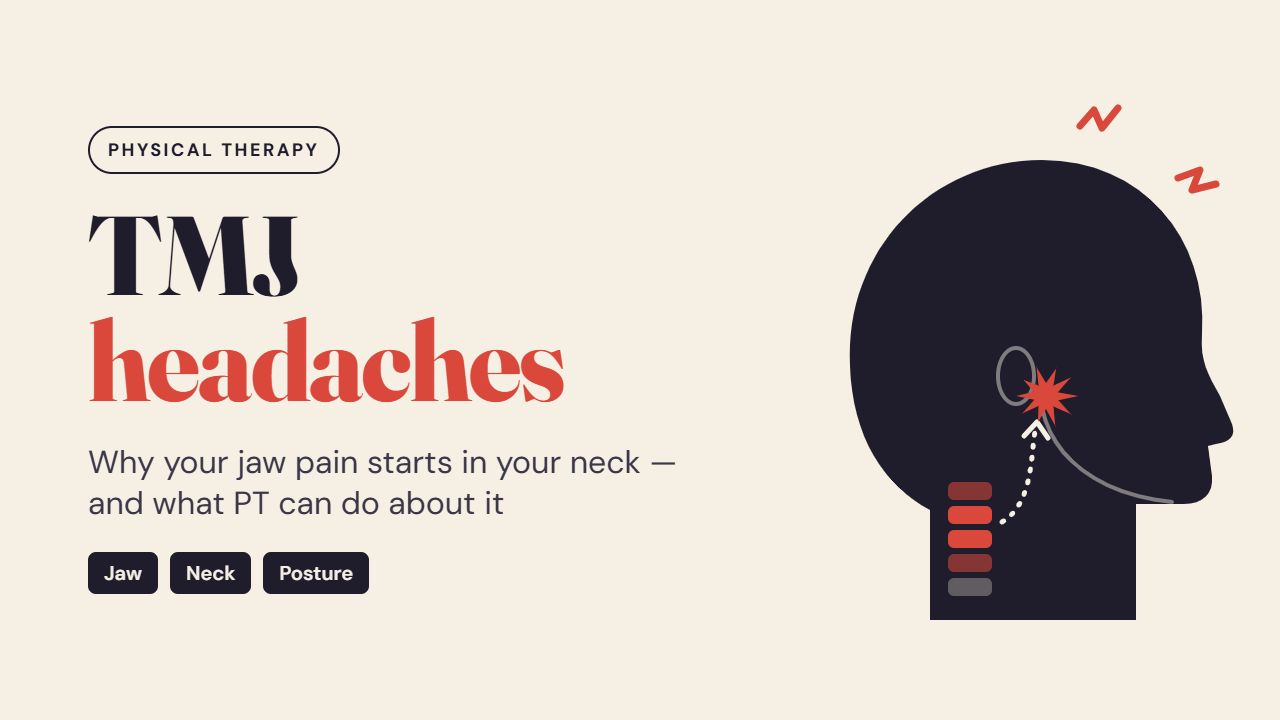
TMJ Headaches: Why Your Jaw Pain Starts in Your Neck — and What Physical Therapy Can Do
You wake up and your jaw already aches. By mid-morning, there’s a dull throb at your temples. By afternoon, the pain has spread behind your ears and down your neck. You take a painkiller, it dulls things for a few hours – and then it’s back.
If this sounds familiar, you’re not imagining things. And no, it probably isn’t just stress or a bad pillow. You may be experiencing TMJ headache – a type of pain that starts in the jaw joint and ripples into the head and neck through a network of shared muscles and nerves.
The good news? TMJ headache treatment through physical therapy addresses the root cause, not just the symptoms. This guide will help you understand what’s actually happening in your body – and what you can do about it.
What Is a TMJ Headache?
TMJ stands for temporomandibular joint – the hinge that connects your jaw to your skull, just in front of each ear. You use it hundreds of times a day: talking, chewing, yawning. When this joint becomes irritated, inflamed, or misaligned, the surrounding muscles and nerves get involved – and they don’t stay local.
A TMJ headache isn’t just jaw pain that spreads. It’s a specific pattern of referred pain that can feel like:
- Throbbing or pressure at the temples
- Aching behind the ears and down the neck
- Facial tightness or a feeling of being locked up
- Jaw soreness that worsens throughout the day
- Tooth sensitivity without any dental cause
The medical term for jaw-related disorders is TMD (temporomandibular dysfunction). TMJ headaches are one of the most common – and most commonly misdiagnosed – symptoms of TMD.
Key fact: TMJ headaches are often mistaken for migraines or tension headaches. If you’ve tried medications without lasting relief, there’s a good chance the true source of pain is the jaw-neck connection.
The Hidden Link: Your Neck, Your Jaw, and Your Headache
Here’s what most people – and even some doctors – miss: the jaw and the neck are intimately connected. They share muscles, nerve pathways, and movement patterns. When one is off, the other compensates. And compensation creates pain.
The cervical spine–TMJ connection
Your cervical spine (the neck) and your TMJ are regulated by many of the same muscles – particularly the suboccipitals, sternocleidomastoid, and upper trapezius. When the neck is stiff or out of alignment, those muscles pull unevenly on the jaw. When the jaw is tense or misaligned, it feeds tension back up into the neck.
This is why treating only the jaw – through a night guard or dental work – often gives partial relief at best. The neck is in the loop too.
Posture is a massive trigger
Think about how many hours a day you spend looking at a phone or laptop. Forward head posture – sometimes called tech neck – shifts the weight of your head forward, increasing strain on the muscles at the base of the skull and across the jaw. For every inch your head moves forward, the effective load on your neck nearly doubles.
This chronic muscular strain eventually reaches the TMJ, setting off a cycle of tightness, compression, and referred pain – all of which show up as headaches.
Shared nerve pathways
The trigeminal nerve – the main nerve of the face and jaw – overlaps with cervical nerve pathways. This is why jaw problems can produce pain that feels like it’s in your forehead, your ear, or even your eye. The brain has a hard time locating where the signal is really coming from.
This phenomenon, called referred pain, is why so many people spend months treating the wrong area.
Common Symptoms People Ignore
TMJ dysfunction rarely announces itself clearly. Instead, it hides behind symptoms that seem unrelated. Here are the warning signs most people overlook:
Clicking or popping jaw with headaches – often points to disc displacement in the TMJ, a structural issue that responds well to PT
Headache behind the ears – a classic TMD pattern, not an ear infection or a tension headache
Jaw clenching headache – waking up with a sore jaw and tight forehead from night-time clenching that overloads the muscles running from jaw to temples
Tension headache from jaw – headaches that build through the day, especially after talking or eating, often trace back to jaw muscle fatigue
You may have TMJ dysfunction if…
- Your headaches are worse in the morning or after meals
- You feel jaw or face pain when you open your mouth wide
- You’ve been told you clench or grind your teeth at night (bruxism)
- Your neck stiffness and headaches arrived together
- Pain medication helps temporarily but keeps coming back
- You feel clicking, locking, or limited movement in your jaw
Root Causes of TMJ Headaches
Understanding what’s driving your symptoms is the first step toward lasting relief.
Bruxism (teeth grinding)
Grinding or clenching your teeth – especially at night — places enormous load on the TMJ and the muscles around it. Over time, this leads to chronic muscle fatigue, joint inflammation, and the characteristic headache that hits before your first cup of coffee.
Forward head posture
When your head sits forward of your shoulders, the muscles at the back of your skull and the base of your jaw are constantly overloaded. This is one of the most common drivers of TMJ neck pain headache that we see clinically.
Stress and muscle tension
Stress causes people to clench their jaw, tighten their shoulders, and brace their neck – often without realizing it. The jaw is one of the body’s primary stress holders, alongside the shoulders and gut. Chronic stress means chronic muscular tension in the jaw and face.
Joint hypermobility or disc displacement
Sometimes the cushioning disc inside the TMJ slips out of place, causing clicking, locking, and localized pain that spreads outward. This is a structural issue that manual therapy can meaningfully address.
Cervical spine stiffness
Stiffness in the upper neck vertebrae – particularly C1, C2, and C3 – directly influences jaw muscle activity. A neck that doesn’t move well forces the jaw to compensate, and the result is strain in both areas.
Why Pain Medications Don’t Fix It
Ibuprofen, acetaminophen, and even prescription muscle relaxants can take the edge off TMJ headaches. But they don’t touch the underlying problem.
TMJ dysfunction is a musculoskeletal issue. The pain comes from joint mechanics, muscle imbalances, nerve irritation, and postural patterns — none of which are addressed by medication. When the drug wears off, the dysfunction remains, and the pain returns.
This is why so many people with jaw and neck headaches cycle through medications, try multiple dentists, and still find themselves waking up with the same ache every morning. The source isn’t chemical — it’s mechanical. And mechanical problems need mechanical solutions.
How Physical Therapy Treats TMJ Headaches
Physical therapy for TMJ is one of the most effective — and most underutilized — approaches to treating jaw and neck-related headaches. Here’s exactly how it works.
Manual therapy for the jaw joint
A skilled PT will assess the mobility of your TMJ and use hands-on techniques to restore normal joint movement. This includes gentle joint mobilizations, soft-tissue massage around the masseter and temporalis muscles, and intra-oral techniques to reduce disc compression and restore smooth jaw gliding.
Cervical spine treatment
Because the jaw and neck are so closely linked, effective physical therapy for TMJ almost always includes cervical spine work. This may involve joint mobilization of the upper neck vertebrae, targeted stretching of tight neck muscles, and strengthening of the deep cervical flexors — the small muscles that control head posture.
TMJ massage therapy and soft tissue release
The muscles most commonly involved in TMJ headaches — the masseter, temporalis, pterygoids, and sternocleidomastoid — respond very well to therapeutic massage and trigger point release. Releasing these trigger points can dramatically reduce headache frequency and intensity within just a few sessions.
Posture correction and ergonomics
Your therapist will assess how you hold your head during daily activities — at your desk, on your phone, while sleeping. Even small adjustments in posture and workplace setup can take significant load off the TMJ and neck.
Neuromuscular re-education
Many people with TMJ dysfunction have learned to use the wrong muscles to control their jaw — often because pain has changed the way they move. Neuromuscular re-education retrains the jaw to open, close, and move along its proper path, reducing wear and tear on the joint over time.
TMJ Physical Therapy Exercises You Can Start Today
These exercises are used in clinical practice for TMJ and jaw pain. Start gently. If any movement causes sharp pain, stop and consult a physical therapist before continuing.
Exercise 1: Controlled Jaw Opening (Tongue on Roof of Mouth)
- Place your tongue lightly on the roof of your mouth, just behind your front teeth.
- Slowly open your mouth as far as comfortable — the tongue acts as a guide to keep the jaw centered.
- Hold open for 3–5 seconds, then slowly close.
- Repeat 10 times, twice daily.
Stop if you feel clicking or locking. This exercise should feel like a gentle stretch, not a strain.
Exercise 2: Chin Tucks (Cervical Retraction)
- Sit or stand with your spine tall and shoulders relaxed.
- Gently draw your chin straight back — like you’re making a double chin.
- Hold for 5 seconds. Release slowly.
- Do 10 repetitions, 3 times daily.
This corrects forward head posture and directly reduces strain on the TMJ via the cervical spine.
Exercise 3: Resisted Jaw Opening
- Place two fingers under your chin.
- Apply gentle upward pressure with your fingers while slowly opening your mouth against the resistance.
- Hold for 5 seconds at the midpoint of opening.
- Repeat 6–8 times, once daily.
Builds strength in the jaw depressors, helping stabilize the TMJ during movement.
Exercise 4: Suboccipital Stretch
- Sit upright. Tuck your chin slightly.
- Place both hands behind your head, interlacing your fingers.
- Gently draw your head forward and down, stretching the base of the skull.
- Hold 20–30 seconds. Repeat 3 times.
Releases the suboccipital muscles — often the primary driver of tension headaches from the jaw-neck connection.
Exercise 5: Side-to-Side Jaw Glides
- Relax your jaw completely.
- Gently slide your lower jaw to the right, hold 2–3 seconds.
- Return to center. Slide to the left, hold 2–3 seconds.
- Repeat 5 times each direction. Do it twice daily.
Improves lateral disc mobility and reduces asymmetrical muscle tension — useful for clicking jaw and headaches.
When Should You See a Physical Therapist?
- Don’t wait until the pain is constant. Consider seeing a PT if:
- You’ve had jaw pain or related headaches for more than 2–3 weeks
- Headaches occur more than 3 times per week
- You notice clicking, popping, or limited jaw movement
- Morning jaw soreness is a regular occurrence
- Over-the-counter pain relief is becoming less effective
- Neck stiffness and headaches seem connected
Earlier treatment means fewer sessions, faster recovery, and a lower chance of the problem becoming chronic.
Looking for Jaw Pain Physical Therapy Near You?
If you’ve been searching for jaw pain physical therapy near me and want a clinic that actually looks at the full picture – jaw, neck, posture, and movement – Physis Rehab is built for exactly this.
Our therapists are trained in both TMJ assessment and cervical spine rehabilitation. We don’t just hand you a sheet of exercises and send you home. Every treatment plan starts with a thorough evaluation of how your jaw and neck are working together – or not.
We see patients across the area who have already been through dentists, neurologists, and primary care without lasting relief. Many of them found the answer in physical therapy – specifically, in treating the jaw and neck as one interconnected system.
Frequently Asked Questions
Yes. In cases of moderate to severe TMD, daily headaches are common — particularly in the morning after a night of clenching or grinding. The muscles around the TMJ don’t fully recover overnight, and pain accumulates. Physical therapy and targeted home exercises can break this cycle by addressing the root cause.
A few clues: your headaches are worse in the morning, you feel jaw tenderness or limited opening alongside the head pain, the headache sits at the temples or behind the ears, and standard headache medications only give partial or temporary relief. A physical therapist can assess whether your jaw and neck are the likely source.
Research and clinical experience both support physical therapy as an effective first-line treatment for TMJ-related headaches. Manual therapy, cervical spine mobilization, postural correction, and targeted exercises can significantly reduce both the frequency and intensity of headaches — often within just a few weeks.
The most effective exercises typically include controlled jaw opening with the tongue on the roof of the mouth, chin tucks for cervical retraction, resisted jaw opening for muscular stability, and suboccipital stretching to release tension at the base of the skull. Consistency matters more than intensity — gentle daily practice beats aggressive weekly efforts.
Most patients notice meaningful improvement within 3–6 sessions. Full resolution of chronic symptoms may take 8–12 weeks depending on how long the dysfunction has been present, posture habits, and how consistently home exercises are performed. Early intervention typically leads to faster, more complete recovery.
Why Choose Physis Physical Therapy
- 15+ Years of Clinical Experience
- 👥 10,000+ Patients Treated
- 📋 Personalized, 1-on-1 Care
- 📅 Same-Week Appointments
- 🏥 Most Insurance Accepted
- 📍 Conveniently Located in Midtown & Basking ridge