
Shockwave Therapy for Shin Splints: Complete Guide
Shockwave Therapy for Shin Splints: Is It the Fix for Pain That Won’t Quit?
You rested for two weeks. You iced. You bought new running shoes. Then, on your first run back along the Hudson River Greenway, the same dull ache crept down the inside of your shin.
That cycle is common. Shin splints often improve with rest and come right back with running, jumping, or long days on hard city pavement. For people whose pain keeps returning, extracorporeal shockwave therapy (ESWT) has become a well-studied, non-surgical option.
This guide explains what shockwave therapy is, how it works for shin splints, what the research says, what a session feels like, and how to find treatment in Midtown Manhattan.
Quick Answer: Does Shockwave Therapy Work for Shin Splints?
Yes, for many people with chronic shin splints, shockwave therapy can reduce pain and speed return to running, especially when combined with a structured loading and return-to-run program. Controlled studies in runners and athletes with medial tibial stress syndrome have shown better recovery with ESWT plus exercise than exercise alone. It is not a standalone cure. It works best as part of a plan that also fixes training load, strength, and movement.
What Are Shin Splints (Medial Tibial Stress Syndrome)?
Shin splints, known medically as medial tibial stress syndrome (MTSS), is an overuse injury that causes pain along the inner edge of the shinbone (tibia), usually in the lower two-thirds of the leg.
The pain comes from repeated stress on the bone and the tissue where muscles attach to it. When the load on the tibia outpaces its ability to adapt, the bone and surrounding tissue become irritated.
Common Symptoms of Shin Splints
- A dull, aching pain along the inner shin
- Tenderness spread over a stretch of bone (often 5 cm or more), not one pinpoint spot
- Pain at the start of a run that may ease, then return after
- Soreness the next morning after activity
- Mild swelling in some cases
Who Gets Shin Splints in NYC?
In Midtown and across Manhattan, we commonly see shin splints in:
- Runners training for the TCS New York City Marathon, half marathons, or loops around Central Park
- Broadway and studio dancers who jump and land on hard stages
- Fitness class regulars doing HIIT, plyometrics, and treadmill intervals
- Commuters and workers who walk miles on concrete every day, often in unsupportive shoes
- New runners who ramp up mileage too fast
What Causes Shin Splints?
The most common cause is a sudden jump in training load: more miles, more speed, more hills, or more days per week without enough recovery. Other known risk factors include:
- A previous history of shin splints
- Excessive foot pronation (a larger navicular drop)
- Higher body weight
- Female sex (partly linked to bone health and energy availability)
- Weak calf, hip, or foot muscles
- Running on hard or uneven surfaces
- Worn-out or poorly matched footwear
Is It Shin Splints or Something More Serious?
Not all shin pain is shin splints. Before any treatment, including shockwave therapy, a clinician should rule out conditions that need a different approach.
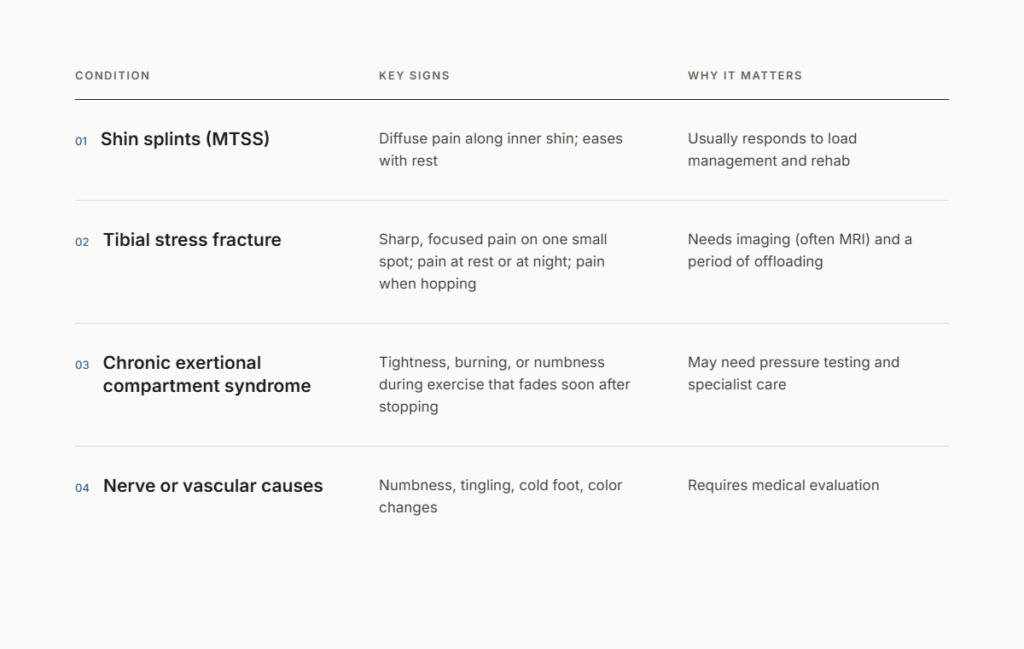
Red flag: If you have pain that is sharp, localized, present at rest, or keeps you up at night, see a clinician before running again. A stress fracture should be confirmed or ruled out before shockwave therapy is applied to that area.
What Is Extracorporeal Shockwave Therapy (ESWT)?
Extracorporeal shockwave therapy (ESWT) is a non-invasive treatment that sends high-energy acoustic (sound) pressure waves through the skin into injured tissue to reduce pain and stimulate healing.
“Extracorporeal” simply means the waves are generated outside the body. No needles, incisions, or medications are involved.
Radial vs. Focused Shockwave Therapy
There are two main types of shockwave therapy:
- Radial shockwave therapy (RSWT): The energy spreads out from the applicator and is strongest near the skin surface. It covers a wider area, which suits the diffuse pain pattern of shin splints. Most shin splint research has used radial devices.
- Focused shockwave therapy (FSWT): The energy converges at a precise depth. It is often used for deeper or more localized problems.
Your clinician chooses the type, intensity, and number of pulses based on your exam, pain level, and goals.
How Does Shockwave Therapy Help Shin Splints?
Shockwave therapy is thought to help shin splints by triggering the body’s repair response, improving local blood flow, and calming pain signals in irritated tissue.
Researchers are still clarifying the exact mechanisms, but the leading explanations include:
- Mechanotransduction: The pressure waves create mechanical stress that cells convert into biological signals, encouraging tissue and bone remodeling.
- Improved blood supply: Studies suggest shockwave therapy promotes the formation of new small blood vessels (neovascularization) in treated tissue.
- Pain modulation: Shockwaves appear to reduce the sensitivity of pain nerve fibers and affect pain-related chemical signals.
- Restarting a stalled healing process: Chronic overuse injuries can get stuck in a low-grade irritated state. Shockwave therapy may help reset that cycle.
In simple terms: rest takes stress off the shin, but it does not always teach the tissue to heal and adapt. Shockwave therapy adds a controlled stimulus that encourages healing, while a rehab program rebuilds the leg’s capacity to handle load.
What Does the Research Say About ESWT for Shin Splints?
The research on shockwave therapy for shin splints is promising but still limited in size. Here is an honest look at the evidence:
- Rompe and colleagues (2010), The American Journal of Sports Medicine: In a controlled study of patients with chronic MTSS, those who received radial shockwave therapy plus a home training program had significantly better recovery rates at follow-up than those who did the home program alone.
- Moen and colleagues (2012), British Journal of Sports Medicine: In athletes with MTSS, adding shockwave therapy to a graded running program led to a faster return to full running than the running program alone.
- Systematic reviews of MTSS treatments generally list ESWT among the more promising options for chronic cases, while noting that most studies are small and more high-quality randomized trials are needed.
What this means for you: Shockwave therapy is not a miracle cure, and results vary. The strongest evidence supports using it alongside a progressive exercise and return-to-run program, not in place of one. That combined approach is how we recommend using it.
Who Is a Good Candidate for Shockwave Therapy for Shin Splints?
You may be a good candidate if:
- Your shin pain has lasted more than 6 to 12 weeks
- Rest, ice, stretching, or new shoes have not solved the problem
- Your pain returns every time you try to run or train
- You want a non-surgical, drug-free option
- You have a race, performance season, or active job you want to return to
- A clinician has ruled out a stress fracture or compartment syndrome
Who Should Avoid Shockwave Therapy?
Shockwave therapy may not be appropriate if you:
- Are pregnant
- Have an unconfirmed or active stress fracture in the treatment area
- Have a tumor, infection, or open wound in the area
- Take blood thinners or have a bleeding disorder (requires case-by-case review)
- Are a child or teen with open growth plates near the treatment site
- Have a pacemaker or other implanted device (requires medical review)
Always share your full medical history with your provider before starting treatment.
What Happens During a Shockwave Therapy Session?
A typical shockwave therapy session for shin splints takes about 10 to 20 minutes, requires no anesthesia, and lets you walk out and return to work right away.
Step 1: Assessment
Your first visit includes a full evaluation: history, training habits, footwear, strength tests, and a hands-on exam of your shin. If anything suggests a stress fracture, your clinician will recommend imaging first.
Step 2: Preparation
A gel is applied to the skin over the painful area to help the waves travel efficiently.
Step 3: Treatment
The clinician moves the handheld applicator along the inner shin, targeting tender regions. You will feel rapid tapping or pulsing. Intensity is adjusted to your comfort.
Step 4: After the Session
You can walk normally and go back to your day. Many Midtown patients schedule sessions before work, on a lunch break, or right after the office.
Does Shockwave Therapy Hurt?
Most people describe shockwave therapy as uncomfortable but tolerable, rated around moderate on a pain scale. The most tender spots feel the strongest. Discomfort usually eases as the session goes on, and your clinician can lower the intensity anytime.
Side Effects
Side effects are usually mild and short-lived:
- Redness of the skin
- Temporary soreness for a day or two
- Minor swelling or bruising
- Rare tingling or numbness that resolves
How Many Shockwave Sessions Do You Need for Shin Splints?
Most shin splint treatment plans involve 3 to 5 sessions, spaced about one week apart.
Some patients notice relief after the first one or two sessions. However, the healing response continues for weeks after the final treatment, so the full benefit often shows up 6 to 12 weeks after starting.
Your exact plan depends on how long you have had symptoms, how severe they are, and how quickly you respond.
Why Shockwave Therapy Works Best With Physical Therapy
Shockwave therapy treats the painful tissue, but physical therapy fixes the reasons the pain developed. Without addressing load and mechanics, shin splints tend to come back.
A complete shin splint plan often includes:
- Load management: Reducing mileage or intensity to a level your shin tolerates, rather than stopping completely
- Calf and soleus strengthening: These muscles absorb impact and reduce stress on the tibia
- Hip and foot strengthening: Better control from the ground up improves how forces travel through your leg
- Gait and running form review: Small changes, like a slightly higher step rate, can reduce impact forces
- Footwear guidance: Matching shoes to your foot type and training
- A graded return-to-run program: A step-by-step progression back to full training
- Bone health check-ins: Discussing nutrition, sleep, and energy availability, especially for high-volume runners
This combined approach reflects how the strongest shin splint studies used shockwave therapy.
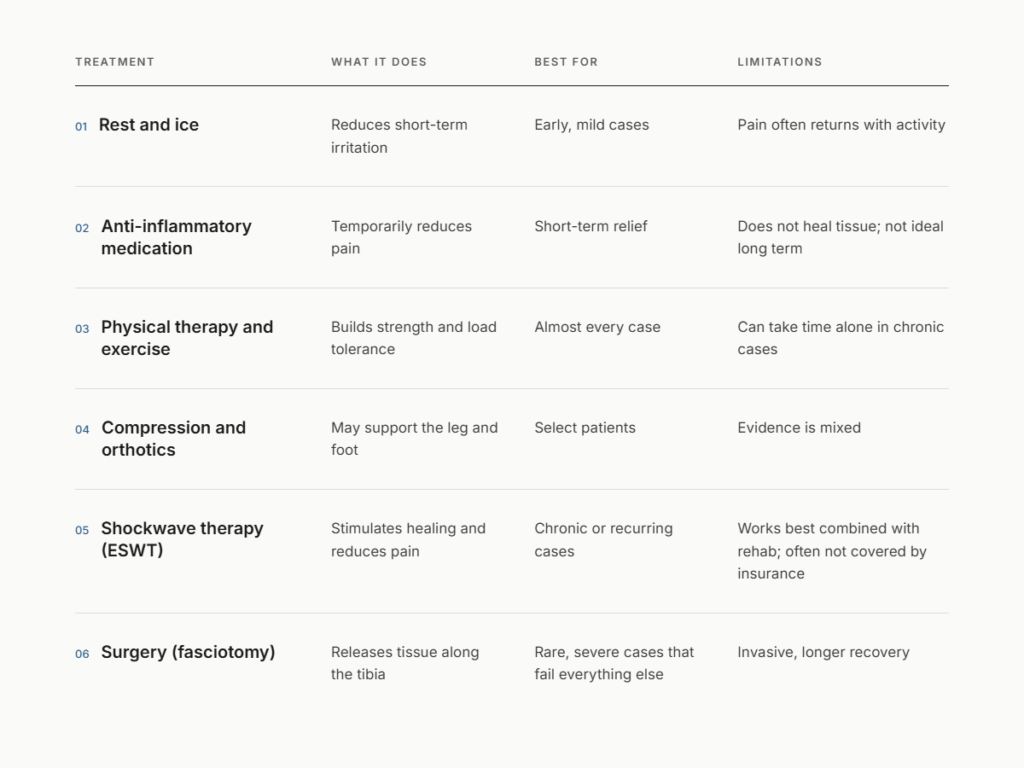
Shockwave Therapy vs. Other Shin Splint Treatments
Shin Splints and the Midtown NYC Lifestyle
Midtown Manhattan creates a perfect setup for shin splints. Consider a typical week:
- Walking between Penn Station, Grand Central, and the office on unforgiving concrete
- Early runs around the Central Park loop or along the West Side Highway
- Evening spin, HIIT, or treadmill classes near Bryant Park or Hudson Yards
- Fall marathon training that adds miles quickly between August and November
That combination of high daily walking volume plus added training is exactly the kind of load spike that overwhelms the shin. It also means many New Yorkers cannot simply “stop walking” for six weeks. A treatment plan that reduces pain while keeping you moving matters here.
Shockwave therapy fits this reality. Sessions are short, require no downtime, and pair easily with a modified training schedule, so you can stay active in the city while your shin heals.
Frequently Asked Questions
Yes, shockwave therapy can be effective for chronic shin splints (medial tibial stress syndrome), especially when paired with a progressive exercise and return-to-run program. Studies show better recovery with this combination than with exercise alone.
Most people need 3 to 5 sessions, about one week apart. Some feel relief early, but full results typically appear 6 to 12 weeks after starting treatment.
Many patients can continue modified running during treatment. Your clinician will set safe limits based on your pain and progress. Avoid hard or long runs immediately after a session unless your provider approves.
It can feel uncomfortable, like rapid tapping on a sore spot, but most people tolerate it well. Your clinician can adjust the intensity to keep you comfortable during the session.
Insurance often does not cover shockwave therapy for shin splints, though policies vary. Check with your provider and insurance company, and ask the clinic about self-pay options and package pricing.
Mild shin splints may settle in a few weeks with reduced activity. Chronic cases can last months or keep returning, especially if training load and strength issues are not addressed.
Physis offers shockwave therapy combined with sports physical therapy in Midtown Manhattan. Book an evaluation to confirm your diagnosis and find out if ESWT is the right fit for you.