
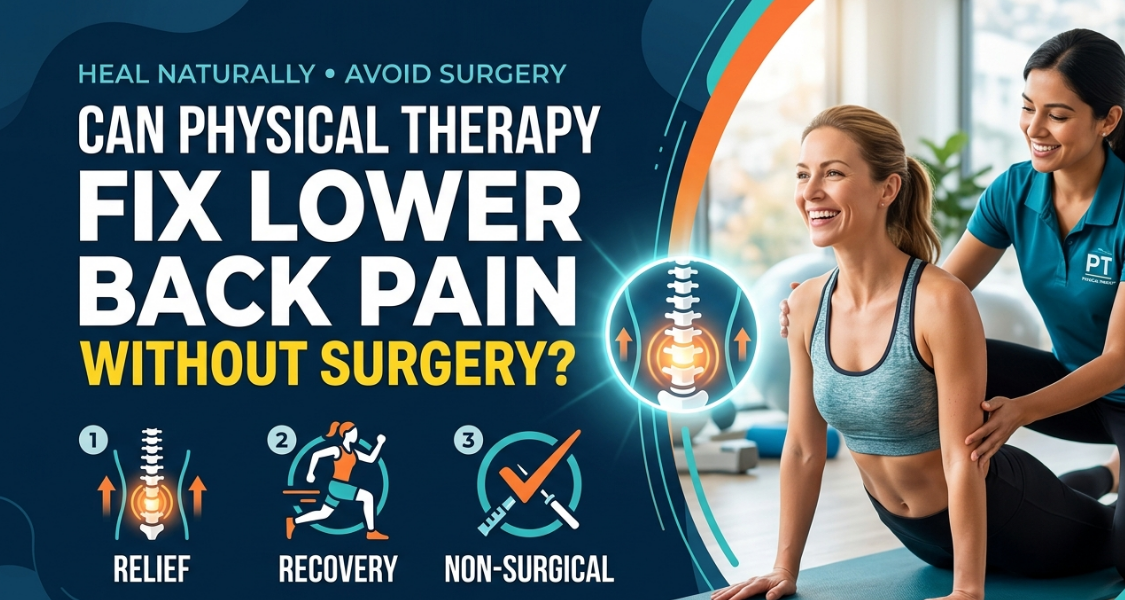
Can Physical Therapy Fix Lower Back Pain Without Surgery?
Yes, physical therapy can genuinely fix lower back pain without surgery for most people. Research published in the Annals of Internal Medicine shows PT produces outcomes equal to surgery for common conditions like spinal stenosis, with far fewer complications. The key isn’t whether PT works — it does. The key is getting the right kind: one-on-one, root-cause focused, built around how your body actually moves. If PT hasn’t worked for you yet, you likely haven’t had the right kind.
If you’re dealing with lower back pain and wondering whether surgery is your only real option, you’re not alone. According to the CDC, nearly 39% of US adults reported back pain in the past 3 months. It’s one of the leading reasons people miss work, stop exercising, and give up the things they love. And too often, the conversation jumps straight to imaging, injections, and the operating room.
But here’s what most people aren’t told: physical therapy for lower back pain — done correctly — resolves the problem for the vast majority of people without surgery. The science backs this up. So does our experience treating thousands of patients at Physis Physical Therapy in Midtown New York City and Basking Ridge, New Jersey. The question isn’t really “can PT fix lower back pain?” It’s “why hasn’t yours been fixed yet?”
Let’s break it all down.
Does Physical Therapy Actually Fix Lower Back Pain, or Just Manage It?
Yes, physical therapy can genuinely fix lower back pain, not just mask it, when it targets the root cause. Multiple clinical trials show that PT produces long-term outcomes equivalent to surgery for the most common lower back conditions, including spinal stenosis and disc herniation. The difference between managing symptoms and fixing the problem comes down to whether your treatment plan addresses the movement dysfunction driving your pain in the first place.
Here’s what that distinction means in practice. Generic PT — the kind where someone hands you a sheet of exercises and watches from across the room — often manages symptoms temporarily. It keeps the pain tolerable but doesn’t change the underlying problem. Root-cause PT works differently. It identifies what’s breaking down in your body’s movement system: a weak core, abnormal neuromuscular patterns, poor spinal alignment, or joint dysfunction. When those are corrected, the pain doesn’t just get managed. It gets resolved.
We see this repeatedly with patients who come to us after months of “treatment” elsewhere. One patient came in after being bedridden with a back injury for four months. Previous providers hadn’t been able to make meaningful progress. A few sessions focused on the root cause changed everything. That’s what targeted, individualized physical therapy can do.
What Does the Research Actually Say About PT vs. Surgery?
For most common lower back conditions, physical therapy and surgery produce equivalent long-term outcomes. A landmark randomized controlled trial published in the Annals of Internal Medicine followed 169 patients with lumbar spinal stenosis, one of the most common reasons for back surgery. At the two-year mark, there was no difference in pain levels or physical function between the group that had surgery and the group that did evidence-based physical therapy.
What was different was the complication rate. Harvard Health reported that 25% of the surgery group experienced surgery-related complications. That’s one in four patients facing repeat operations, infections, or other serious events. In the PT group, only 10% reported worsening symptoms. Same two-year outcome, but surgery carried 2.5 times more complications.
This isn’t one isolated study. The SPORT trial published in JAMA reached similar conclusions for disc herniation. The evidence consistently points in the same direction: starting with rigorous, structured PT produces results comparable to surgery for most patients — with far less risk.
Why Most Lower Back Pain Doesn’t Need a Surgeon
The vast majority of lower back pain cases resolve with conservative, non-surgical care. A neurosurgeon at Novant Health summarized it plainly: over 80% of Americans will experience back pain at some point in their lives, but 75% of symptoms improve with conservative management alone. Surgery is a last resort, not a first step.
The American College of Physicians (ACP) reinforced this in its clinical practice guideline, recommending non-pharmacological interventions — including physical therapy — as the first-line treatment for acute, subacute, and chronic low back pain. Conservative care should be tried before surgery is even considered.
That’s especially relevant given how many conditions respond well to PT. The list includes disc bulge and herniation, degenerative disc disease, lumbar stenosis, sacroiliac joint dysfunction, sciatica, piriformis syndrome, nerve impingement, scoliosis, and core or gluteal muscle weakness. In other words: most of what’s putting you in pain can be treated without anyone touching a scalpel.
The critical point is timing. Seeking high-quality PT early — before things become chronic — dramatically improves outcomes. The longer you wait, or the longer you spend in mediocre PT, the harder the road back becomes.
How Physical Therapy Actually Heals the Lower Back
Physical therapy heals the lower back by restoring the neuromuscular patterns, core stability, and movement control your spine depends on — not just by reducing pain. The spine doesn’t work in isolation. It depends on a system of deep stabilizing muscles, including the diaphragm, multifidus, transverse abdominis, and pelvic floor. When this system breaks down, the entire spine becomes vulnerable to strain and injury.
Here’s what that looks like in practice. Your lumbar spine is designed to move in coordination with your pelvis, hips, and thoracic spine. When movement patterns become abnormal — from an old injury, poor posture, a sedentary job, or compensations built up over years — the wrong structures carry the load. Discs compress. Joints inflame. Muscles go into protective spasm. You feel it as pain. But the pain is a symptom. The movement dysfunction is the cause.
At Physis Physical Therapy, we use approaches that work directly on correcting those dysfunctional patterns:
Dynamic Neuromuscular Stabilization (DNS) works to reactivate the deep stabilizing system of the spine. It retrains how your nervous system controls movement, targeting the muscles that protect your back during everyday activities.
The McKenzie Method uses repeated, direction-specific movements to reduce disc-related pain and restore spinal mechanics. Research consistently supports its effectiveness for acute and chronic lower back conditions.
Manual therapy, the Mulligan Approach, and Sahrmann’s Method address joint restrictions, movement impairments, and muscle imbalances that generate pain signals. These techniques require a skilled, hands-on provider — not a machine or a generic exercise sheet.
For sacroiliac joint dysfunction, a frequently under-diagnosed source of lower back pain, targeted manual therapy combined with specific stabilization exercises addresses both the joint dysfunction and the core weakness that allowed it to develop.
Each treatment plan at Physis Physical Therapy is different, because each patient is different. That’s not a platitude. It’s how you actually get better.
When Surgery IS the Right Answer for Lower Back Pain
It’s important to be clear: surgery is sometimes the right answer. We’re not anti-surgery. We’re pro-getting-the-right-treatment-for-your-situation.
There are specific circumstances where surgery is necessary and shouldn’t be delayed:
Cauda equina syndrome is a medical emergency. The American Association of Neurological Surgeons explains that when the bundle of nerves at the base of the spinal cord is severely compressed, it can cause permanent paralysis and loss of bladder and bowel function if not surgically decompressed — ideally within 48 hours of onset. If you experience sudden loss of bowel or bladder control, numbness in the saddle area (inner thighs and groin), or rapidly progressing leg weakness, go to the emergency room immediately.
Other situations that warrant surgical evaluation include: progressive neurological deficits (worsening leg weakness or foot drop), spine fractures, known spinal instability, spinal tumors or infections, and cases where 6-12 weeks of high-quality conservative care has genuinely failed to produce improvement.
The key phrase is high-quality. If your PT consisted of heat packs and a handout, that’s not an adequate trial of conservative care. You should exhaust truly individualized physical therapy before accepting surgery as the answer.
For patients who do need surgery, pre-surgical rehabilitation makes a meaningful difference in outcomes. Stronger, better-conditioned tissue heals faster. Post-surgical PT is equally essential — the surgery fixes the structural problem, but it doesn’t restore the movement patterns that protect your back long-term.
What Makes Physical Therapy “Work” vs. Fall Short
The reason physical therapy fails for so many people isn’t that the concept doesn’t work. It’s that the execution is often inadequate. Generic, one-size-fits-all programs built around machines, exercise sheets, and a therapist stretched across six patients at once don’t address the root movement dysfunction that’s causing your pain.
Real PT — the kind that actually resolves lower back pain — looks very different. It starts with a thorough, whole-body evaluation. Not just a look at your back, but an assessment of how your entire movement system is functioning: your breathing mechanics, your pelvic control, your hip mobility, your foot and ankle position. The back is rarely the only thing broken.
It continues with one-on-one time, every session, with a therapist who knows your case. At Physis physical therapy, patients get their full session with the therapist, not a few minutes of hands-on work sandwiched between patients. Our reviews consistently describe this as what made the difference after years of unsuccessful treatment elsewhere.
One Olympian, Dan Veatch, came to us after breaking two vertebrae skiing. He’d seen multiple physical therapists in San Francisco and New York without meaningful progress. Through a combination of manual therapy, targeted exercise, and shockwave therapy, he regained his mobility and returned to his exercise routine. His words: Dr. Pandya is one of the most skilled, focused and instinctive therapists I have ever seen.
That’s the level of attention your lower back deserves.
What to Expect from Lower Back Physical Therapy at Physis Physical Therapy
When you come to Physis Physical therapy with lower back pain, the first thing we do is listen. We want to understand your full history: how long the pain has been there, what makes it better or worse, what you’ve already tried, and what you want your life to look like on the other side of this.
From there, we conduct a comprehensive movement evaluation. We’re looking at your whole body, not just the area that hurts. Our approach is built on the understanding that abnormal movement patterns, core instability, and compensation strategies are the usual drivers of lower back pain — and that treating those root causes produces lasting relief where narrowly focused treatment falls short.
Your treatment plan will draw from the most effective techniques for your specific situation. For most lower back patients, this includes hands-on manual therapy, specific neuromuscular re-education, therapeutic exercise, and education on how to maintain your gains at home. In some cases, we may incorporate Extracorporeal Shockwave Therapy to accelerate tissue healing, particularly for chronic or stubborn presentations.
Most patients start feeling meaningful improvement within the first few sessions. Full resolution takes longer, but the trajectory changes quickly when the treatment is right.
If you want to learn more before your first appointment, we’ve put together a free lower back resource guide with practical information to help you understand what’s happening in your back and what to do about it.
The Bottom Line
Physical therapy can fix lower back pain without surgery for the vast majority of people. The science is clear, the clinical evidence is strong, and the outcomes speak for themselves. But you need PT that addresses root causes — not a program that just manages symptoms until they come back.
If your back pain hasn’t responded to treatment yet, the answer probably isn’t surgery. It’s better treatment.
At Physis Physical Therapy in Midtown New York City and Basking Ridge, New Jersey, we treat the whole body, not just the pain. We’ll find out what’s actually driving your lower back pain and build a plan designed to fix it.
Call our NYC clinic at 212-706-7480 or our NJ clinic at 908-484-7600 to schedule your appointment today. You don’t have to keep living like this.
Frequently Asked Questions
Can physical therapy fix a herniated disc without surgery?
Yes, physical therapy can resolve symptoms from a herniated disc without surgery in most cases. Conservative treatment is the first-line approach for lumbar disc herniation, and many patients achieve full recovery through targeted PT that restores spinal mechanics, reduces nerve irritation, and corrects the movement patterns that contributed to the injury. Surgery is typically considered only when neurological symptoms are rapidly progressing or when high-quality conservative care over 6-12 weeks has not produced improvement.
How long does physical therapy take to relieve lower back pain?
Most patients begin to feel meaningful improvement within the first two to four sessions when treatment is properly targeted. Full resolution of chronic lower back pain typically takes anywhere from 6 to 16 sessions, depending on how long the condition has been present, its underlying cause, and how consistently the patient performs their home exercises. Acute flare-ups often resolve faster. The timeline accelerates significantly when treatment addresses root causes rather than just symptoms.
What’s the difference between regular PT and the kind that actually works?
The key difference is one-on-one, root-cause focused care versus a generic, volume-based program. Effective PT begins with a whole-body evaluation, not just a look at the painful area. It involves hands-on manual therapy, specific neuromuscular retraining, and an individualized exercise plan. The therapist works with you for the full session every time. Generic PT, by contrast, often involves a standard protocol, minimal direct therapist contact, and exercises that don’t address the specific movement dysfunction causing your pain. Same label, very different results.
Is it safe to try physical therapy before deciding on back surgery?
Yes, and for most lower back conditions it’s both safe and strongly recommended. The American College of Physicians guidelines recommend non-pharmacological care, including PT, as the first-line treatment for low back pain. The exception is if you’re experiencing red flag symptoms such as loss of bowel or bladder control, rapid progressive leg weakness, or signs of cauda equina syndrome — those require emergency evaluation, not PT. For all other presentations, a rigorous trial of high-quality PT before surgery is both safe and scientifically supported.
Does lower back physical therapy work for sciatica?
Yes. Sciatica, which refers to pain that radiates from the lower back down the leg along the sciatic nerve, typically responds well to physical therapy. The goal is to reduce compression or irritation of the nerve root through a combination of manual therapy, nerve mobilization techniques, specific exercise, and postural correction. The McKenzie Method in particular is well-supported for sciatica, as its directional movement approach is specifically designed to centralize and reduce radiating pain. Most patients with sciatica can avoid surgery with the right PT program.